Date: Wed, 6 Dec 2023 15:46:23 -0400
Dear Colleagues,
May we please draw on your expertise for help with our (700 MHz) Bruker
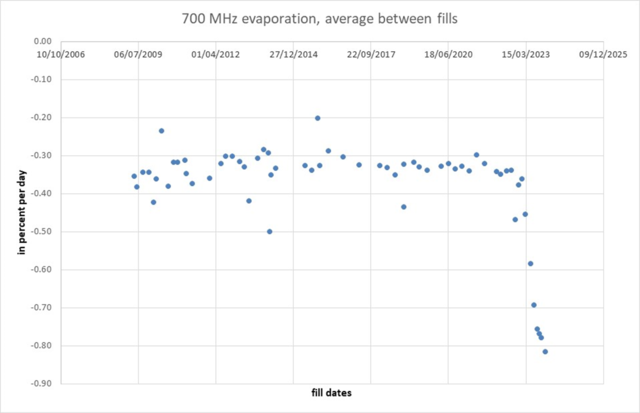
magnet problem? Here is the issue: Our daily evaporation rates have
continually increased starting about March 2023. I show a graph to that
effect at the end of this e-mail. What I plot there is the average slope
between magnet fills. From when the magnet was set up in 2004 until about
March 2023 the slope of the helium content has been on the order of -0.33
percent per day. We are now at about -0.8 % per day tending towards 1% per
day..
We are stumped on what is going on and how we can get back to a lower
evaporations. Here are some tests, observations and data we have:
1) Vacuum not getting worse: The nitrogen consumption is unchanged. Unless
the helium coil is in its own vacuum chamber, we think it is unlikely
that the vacuum is deteriorating. Do you agree?
2) Cryoshims are not getting bad: Without any RT shims, the liquid
lineshape of a static liquid sample is about 93 Hz wide, FID lasts 0.5s,
which is plenty good for our solid state NMR. Using our "latest" shim file
(you will laugh, from March 2022) the lineshape easily resolves 6 Hz. The
shims are good for ssNMR. We checked every single time and had no reason to
change the RT shims. Also, if a cryoshim would have gotten bad, I would
have expected a short burst and then no change again.
3) Shim coil temperature? Without any RT shims, the coil temperature reads
25 degree C. With the "latest" shim file the temperature reads 26 degree C.
4) EAPD : We took it out of the system for a while (one week or so). The
helium evaporation does not change.
5) Helium recovery: The helium liquifier system was installed in Feb. 2022,
more than a year before the evaporation rate increased. In our rather noisy
data analysis and limited data, our recovery fraction has not changed,
meaning we are recovering a lot of the increased evaporation. (Thanks! We
would be in even more trouble than we are in already).
6) Overpressure: Because of the helium recovery system the 700 MHz magnet
was always at slightly elevated pressure, compared to atmosphere, due to
the liquifier header pressure. I don't see how internal frost could have
built up when the system was bleeding helium out rather than getting air
in.
7) SLCB sensor board, Yes, our sensor board in the BSMS was flaky, for
years already. We always had to take a big average (5 readings) to get a
sensible state of the helium level. However, even completely unhooking the
sensor line from the magnet (terminating the cable with the black plug) did
not make any difference to the evaporation rate (testing for about one
week). We recently exchanged the board and I am impressed how reliable the
measurements are now. But also, the evaporation rate has not improved.
8) O-rings: A Bruker engineer was here to install a new spectrometer for
another lab. He came to our lab in preparation for a new installation,
which we will get soon. He looked at the O-rings on the fill stack and
found them to be in good shape. We did not look at O-rings on other
stacks.
9) Unfortunately, he also mentioned that our ceiling is not high enough to
take out and defrost the sensor. Maybe we can move it up a bit and try to
defrost it then, in the hope that that does not introduce more frost than
can be removed. It seems to me a risky maneuver overall, not just because
of the electrical impact.
10) Leak testing: We have tested for helium leaks as much as we could and
found that the Bruker one way valve leaked out some helium. We have now
added teflon around the joints. Since the system is on helium over-pressure
to the outside air pressure that should not have caused frost to get in?!
A handheld leak tester was purchased recently, but had to be returned . We
hope to use it for detailed tracing when we get it back.
11) What happened in March that could have brought about such a change?
Frankly, we don't know. Around that time, we had our one year helium
liquifier service. BTW, our other magnet behaves just like before, so we
don't think that the liquifier system has introduced a problem. Also, we
did Variable Temperature experiments, which for years we have not done, but
the temperatures were not dramatic. Since then, the VT unit is not
connected to the probe heads.
Do you have any suggestions of what we can do to get back to the much
better evaporation rates? It baffles us that the rise in evaporation rate
is so slow over more than half a year by now. Do you have any suggestions
on what could go on here and how to remediate it?
Has anybody seen anything like this before and what did you do about it?
Thanks for your insights.
Happy resonating.
Ulli
[image: image.png]
--
Dr. Ulrike Werner-Zwanziger
Adjunct Professor
Department of Chemistry, NMR-3,
Dalhousie University
6274 Coburg Road
PO BOX 15000
Halifax, NS B3H 4R2
e-mail: Ulli.Zwanziger_at_Dal.ca
Tel. 1 902 494 8085
FAX: 1 902 494 1310
-=-=-=-=-=-=-=-=-=-=-=-
Groups.io Links: You receive all messages sent to this group.
View/Reply Online (#842): https://urldefense.com/v3/__https://ammrl.groups.=
io/g/main/message/842__;!!PvDODwlR4mBZyAb0!XQHdjkk55pUhVCfilIRwXJICc0xwcPMY=
p80mxHFte0-gAO8kvzQjUstcKpoDPioJT36fvqxgzPNkQ8Suwg6p6NJt$
Mute This Topic: https://urldefense.com/v3/__https://groups.io/mt/103020605=
/7559972__;!!PvDODwlR4mBZyAb0!XQHdjkk55pUhVCfilIRwXJICc0xwcPMYp80mxHFte0-gA=
O8kvzQjUstcKpoDPioJT36fvqxgzPNkQ8SuwjuR8Sdp$
Group Owner: main+owner_at_ammrl.groups.io
-=-=-=-=-=-=-=-=-=-=-=-
(image/png attachment: image.png)