Date: Fri, 15 May 2015 11:09:53 -0400
Hi Weixing,
The spin system of 15N-labeled urea is more complicated than two simple
A2X. The two N's of urea are magnetically non-equivalent, so are the two
H2's. We can consider it as a A2A'2XX' system (X,X'=15N; A,A'=1H).
Attached are 1H and 15N spectra simulated using SpinWorks with the
following estimated J values (I don't have accurate J values of urea on
hand, and chemical shifts are not important in this simulation):
J(X,A2)=J(X',A'2)=88Hz, J(X,X')=4.6Hz, J(X,A'2)=J(X',A2)=1.8Hz,
J(A2,A'2)=1.0Hz. The simulated spectra show the same features as you
observed.
Best,
XFG
On 5/14/2015 2:53 PM, Zhang, Weixing wrote:
> Hello All:
>
> I recorded 1H and 15N spectra of 15N-labeled urea in DMSO.
>
> Both 15N-decoupled 1H and 1H-decoupled 15N spectra have single peak.
>
> Without decoupling, both 1H and 15N spectra show a small splitting of ~4
> Hz (see attached pictures).
>
> Does anybody have an explanation of the splitting pattern?
>
> Thanks,
>
> Weixing Zhang
> St. Jude Children’s Research Hospital
> Memphis, TN 38105
--
Xinfeng (Frank) Gao, Ph.D.
Director of NMR Facilities
Department of Chemistry
Indiana University
800 E. Kirkwood Ave.
Bloomington, IN 47405-7102
Phone: (812) 855-6492
Email: xgao_at_indiana.edu
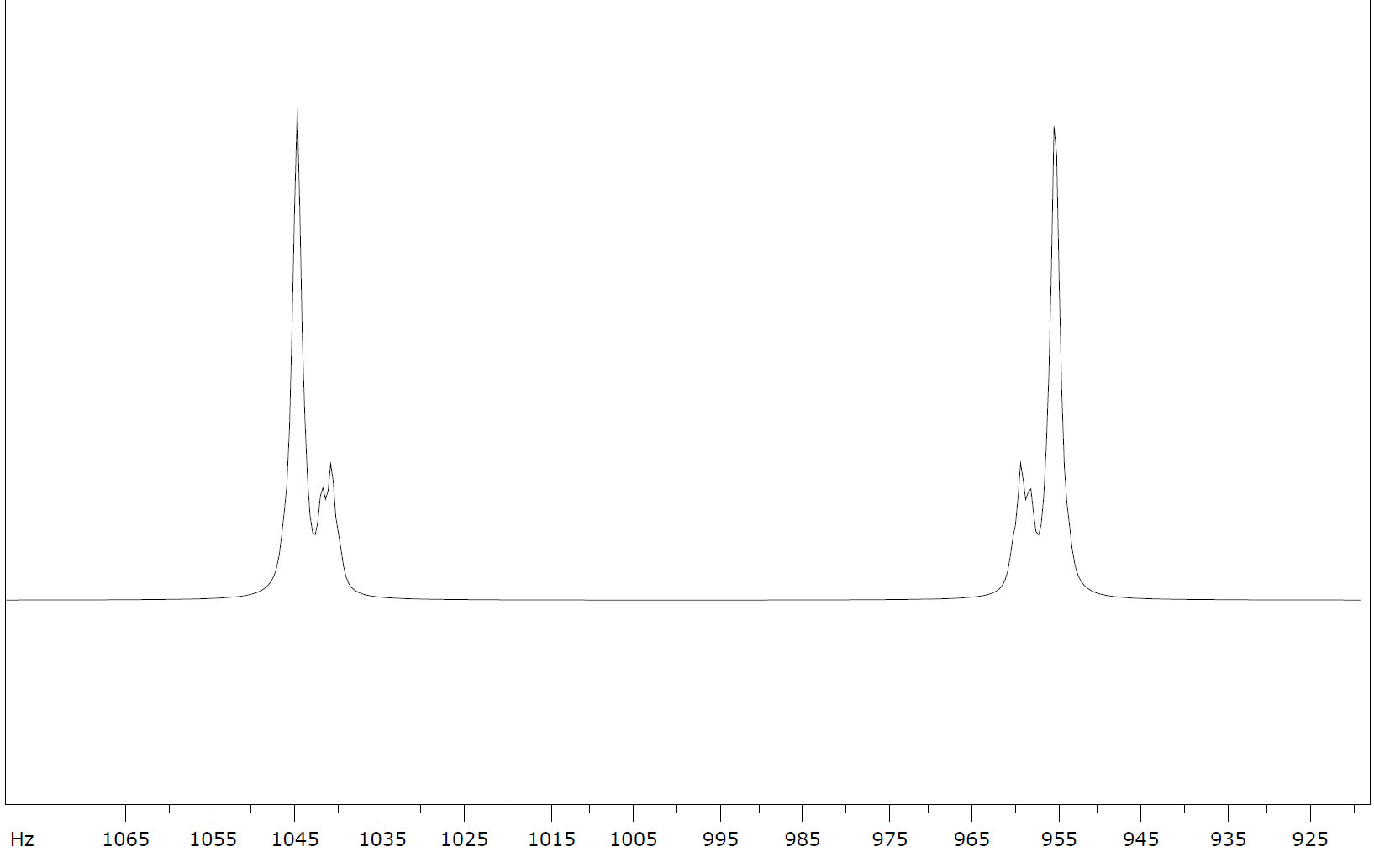
(image/jpeg attachment: Urea-1H.jpg)
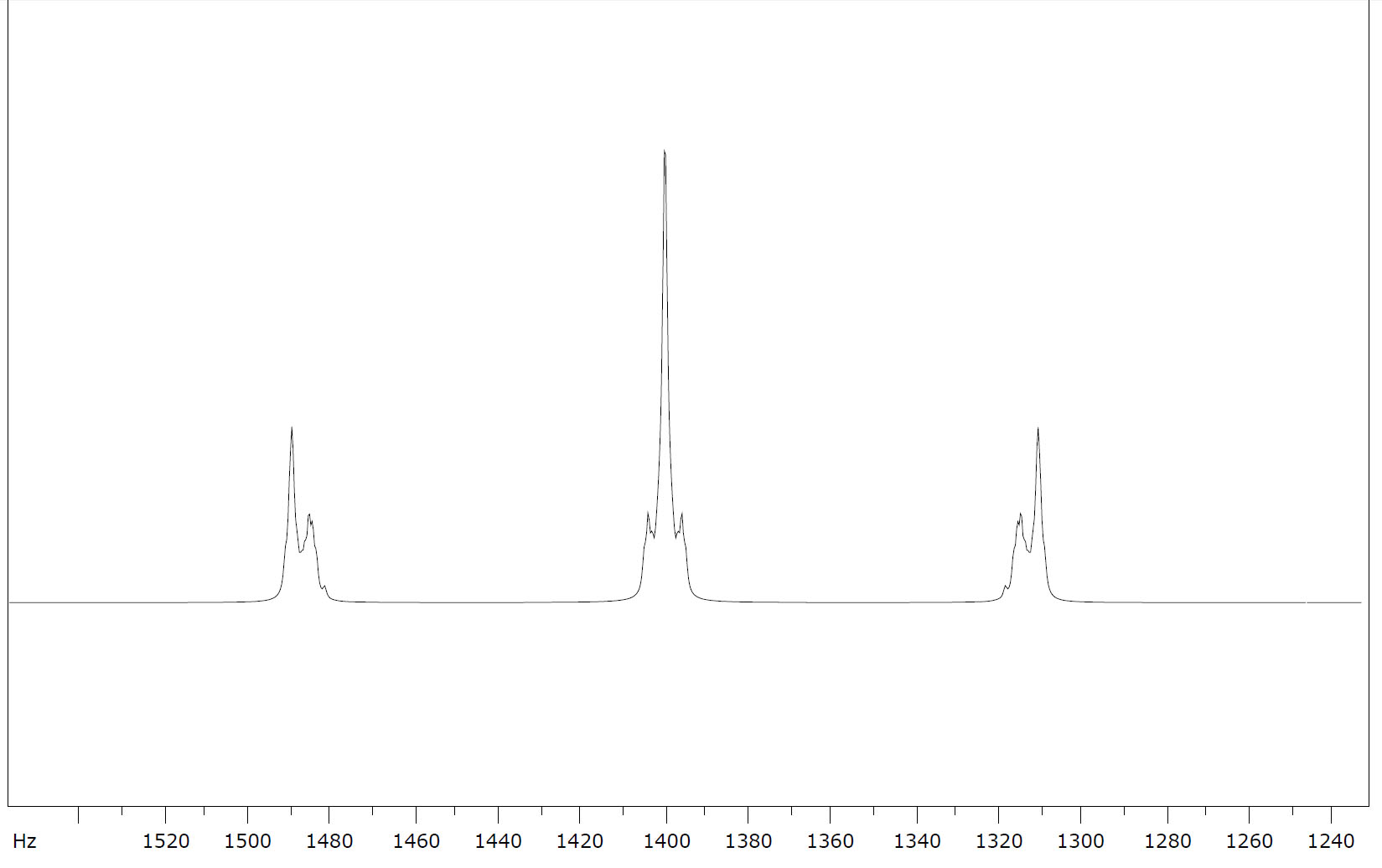
(image/jpeg attachment: Urea-15N.jpg)