Date: Thu, 17 Mar 2016 19:38:34 +0000
Hello, Everyone,
Here is another comment or two on the topic of the slotted tip on the helium transfer line.
We always use the tip to direct helium liquid (and maybe cold gas) upward in the helium entry tube of the magnet. About 2 years ago, we purchased a new transfer line from Oxford. It came with such a tip. However, I just worked here with a group that purchased a supercon magnet, included in their new Bruker FT-MS system. That new helium transfer line has no such tip, but the Bruker tech recommended that they get one. That’s like Ken Knott’s original story. That group will either find a vendor, or have the tip machined. I presume that the transfer line tips are threaded to add an extender if needed. It is still odd that Bruker recommends a slotted tip, but does not provide one to the user.
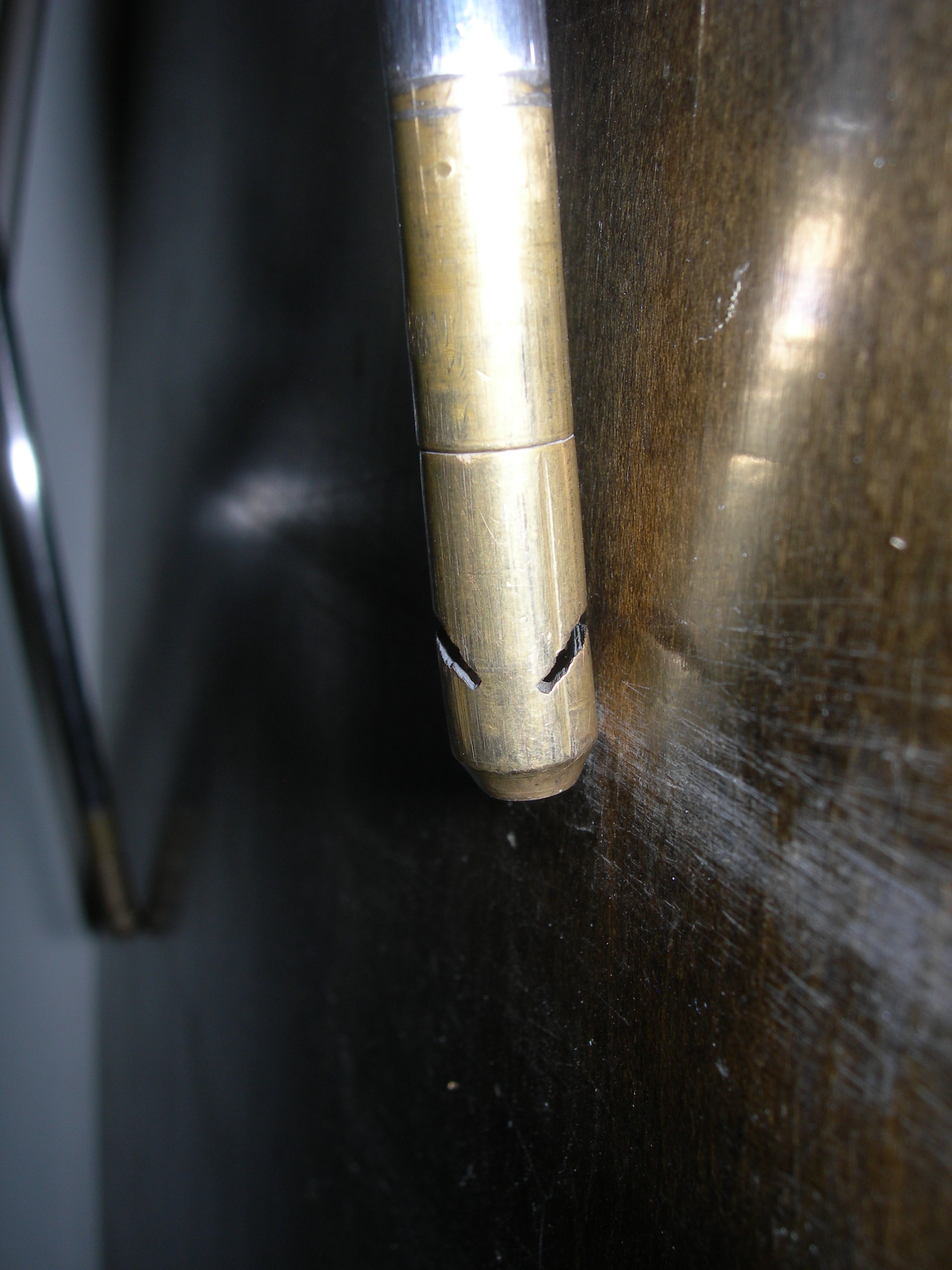
A typical fitting is in the photo to clarify the topic and make sure we are all referring to the same thing.
Dean
***********************************
Dean L. Olson, Ph.D.
Director, NMR/EPR Lab, 146 Roger Adams Lab
School of Chemical Sciences
U. of Illinois at Urbana-Champaign
600 S. Mathews, Box 81-5, MC-712
Urbana, IL 61801 USA
Lab: 217-244-0564; Cell: 217-722-9432
dolson_at_illinois.edu<mailto:dolson_at_illinois.edu>
http://scs.illinois.edu/nmr
http://scs.illinois.edu/epr/
***********************************
From: Joseph Dumais [mailto:josephdumais_at_boisestate.edu]
Sent: Wednesday, March 16, 2016 12:56 PM
To: Olson, Dean
Cc: Kenneth Knott; ammrl_at_ammrl.org<mailto:ammrl_at_ammrl.org>
Subject: Re: AMMRL: Helium transfer 'Christmas Tree' fitting
I am curious how many people are using these slotted tips on the delivery side of the transfer tubes?
I have seen them around at magnet sites but rarely see them in use. In addition to what Dean said about clogging I could also see that it might be a means of being sure that you do not direct a jet of "warm" (i.e. a few degrees above the boiling point of liquid Helium) Helium gas downwards. This is particularly important given that many current magnets now have the top of the magnet above the liquid level at the standard fill time. Many old Oxford dewar designs had the magnet still under liquid even at 0% Helium reading at the standard fill time.
Joe
*******************************
Joe Dumais, Ph.D.
Associate Research Professor/Nuclear Magnetic Resonance Spectroscopist
Boise State University
College of Arts and Sciences
Department of Chemistry and Biochemistry
1910 University Drive, Boise, Idaho 83725-1520
(208) 426 4913
http://chemistry.boisestate.edu/<https://urldefense.proofpoint.com/v2/url?u=http-3A__chemistry.boisestate.edu_&d=BQMFaQ&c=8hUWFZcy2Z-Za5rBPlktOQ&r=_xOiX549pJbDrYO1KcviQBn2_SODCSmI1uxHD-lpwqs&m=c1LdxSPPUJOMj5OUoxGCkcGe0ztCENuXcUlo4aLMBZ4&s=wHl3SAlk7F2323NowGOWCpHa7zPfONWElNTmSdEJeEQ&e=>
*******************************
Sent from an MS Windows PC
On Mon, Mar 14, 2016 at 12:08 PM, Olson, Dean <dolson_at_illinois.edu<mailto:dolson_at_illinois.edu>> wrote:
The tip is designed to never clog by hitting any ice debris inside the magnet. When the tip is inserted downward into the magnet, the slots in the tip point upward so the liquid helium or nitrogen can always emerge without obstruction. Turn this object over and look at it in your hand, and the slot angle might make it look like a little pine tree.
One can only wonder why the new helium transfer line does not come with an appropriate fitting.
***********************************
Dean L. Olson, Ph.D.
Director, NMR/EPR Lab, 146 Roger Adams Lab
School of Chemical Sciences
U. of Illinois at Urbana-Champaign
600 S. Mathews, Box 81-5, MC-712
Urbana, IL 61801 USA
Lab: 217-244-0564<tel:217-244-0564>; Cell: 217-722-9432<tel:217-722-9432>
dolson_at_illinois.edu<mailto:dolson_at_illinois.edu>
http://scs.illinois.edu/nmr
http://scs.illinois.edu/epr/
***********************************
From: Kenneth Knott [mailto:kknott_at_vt.edu<mailto:kknott_at_vt.edu>]
Sent: Monday, March 14, 2016 11:55 AM
To: ammrl_at_ammrl.org<mailto:ammrl_at_ammrl.org>
Subject: AMMRL: Helium transfer 'Christmas Tree' fitting
A neighboring institution is getting a new Bruker 400 system installed and they've been told they need to get a 'christmas tree' adapter/fitting for their transfer line. Their engineer hasn't been to helpful telling them where to get one.
We have one that we've had for ever, but not really sure where it originated from.
Any suggestions? And how exactly did this thing come to be known as a christmas tree???
Thanks!!
--
Ken Knott
Department of Chemistry
Analytical Services
Virginia Tech
(540)267-6502<tel:%28540%29267-6502> (Cell)
(540)231-0885<tel:%28540%29231-0885> (Office)
(image/jpeg attachment: Helium_Transfer_Line_Tip.JPG)