Date: Tue, 24 Jun 2025 16:43:00 -0700
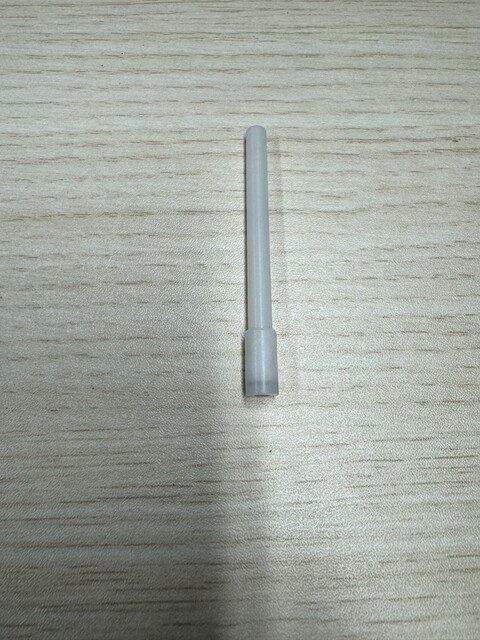
Thank you for sharing that rather useful tip, George and Gary. For the 5
to 3 mm, in our systems, I use the adapter like the one below with our
existing 5 mm spinners. It works well.
Best
Rajan
On Tue, Jun 24, 2025 at 3:51 PM Olson, Dean via groups.io wrote:
> It might be easier to use this product:
>
> https://www.cortecnet.com/us/ne-h5-3-micro-nmr-sample-tubes-varian-5-3mm.html?___store=us_storeview&___from_store=defaul
>
>
> ***********************************
>
> Dean L. Olson, Ph.D.
> Director, NMR/EPR Lab
> 146 Roger Adams Lab
> School of Chemical Sciences
> U. of Illinois at Urbana-Champaign
> 600 S. Mathews, Box 31-1, MC-712
> Urbana, IL 61801 USA
> Lab: 217-244-0564; Cell: 217-722-9432
> dolson_at_illinois.edu
> http://scs.illinois.edu/nmr
> http://scs.illinois.edu/epr/
> ***********************************
>
>
>
> *From:* main_at_ammrl.groups.io * On Behalf Of *george gray via groups.io
> *Sent:* Tuesday, June 24, 2025 12:32 PM
> *To:* main_at_ammrl.groups.io
> *Subject:* Re: [AMMRL] New Error on Varian 400MR
>
> Using a smaller diameter sample (3mm sample inside of a 5mm probe) can
> have a dramatic reduction of the salt effect. If you have a 3mm turbine,
> just use that turbine for a 3mm tube. You will, of course, have a hit on
> filling factor, but the tuning should be closer to that of a non-lossy
> sample, so you'll not suffer the full loss. You might be able to tune the
> probe properly and determine the 90-degree pulse length.
>
> If you don't have a 3mm spinner turbine you can place the 3mm sample
> inside a 5mm tube. I recall doing this many, many years ago when I had to
> have a 13C lock signal to do time averaging to do 13C (cw!) observe on a
> 100MHz (proton) spectrometer. The S/N ratio was about 2 for this lock, but
> it did work. I recall using a thin piece of teflon, cutting out triangles
> that would fit inside a 5mm tube and then punching out holes for a 2mm
> capillary containing the enriched carbon disulfide.
>
> A side benefit for the 3in5 approach is that you can use any lock solvent
> (non-salty organic, for example) in the outer space.
>
>
> On 6/24/2025 9:33 AM, Vander Velde, David via groups.io wrote:
>
> Yes, assuming that's the 1H match control on your system (it's channel 6
> on mine). High ionic strength samples drive the match towards its minimum
> value, and once you reach that in a particular probe, you're out of luck
> with getting the sample properly matched.
>
> Setting aside the question of whether it's necessary or advisable to
> prepare a sample like that, you can still get some kind of 1H spectrum by
> skipping probe tuning, taking some big hit on sensitivity. Some experiments
> are not going to work or not advisable, like 13C with 1H decoupling—you'd
> get high reflected power back from a mismatched probe, and the normal
> decoupling parameters will fail.
> ------------------------------
>
> *From:* main_at_ammrl.groups.io on behalf of Stephen Nolte via groups.io
> *Sent:* Tuesday, June 24, 2025 8:13 AM
> *To:* main <main_at_ammrl.groups.io> <main_at_ammrl.groups.io>
> *Subject:* [AMMRL] New Error on Varian 400MR
>
> Hi all,
>
> Summer research students elicited a new intermittent error this week on
> our Varian 400MR failed - rf signal too weak on tune chan#5.
>
> Can this be related to high levels of ionic salts in the sample?
>
> Thanks!
>
> _______________________________
>
> Stephen Nolte | Chemistry Technician
> Millersville University
> 717-871-7413
>
>
-=-=-=-=-=-=-=-=-=-=-=-
Groups.io Links: You receive all messages sent to this group.
View/Reply Online (#2453): https://urldefense.com/v3/__https://ammrl.groups=
.io/g/main/message/2453__;!!PvDODwlR4mBZyAb0!Sd9HtFT50Buz2WbFM4akmIZDoONZWF=
xuIgI2iYvGlbL5xNI40EJDK8_BNv0lR7FeZbVcVG3MyFRf91Y9tjAPOOZ2$
Mute This Topic: https://urldefense.com/v3/__https://groups.io/mt/113809292=
/7559972__;!!PvDODwlR4mBZyAb0!Sd9HtFT50Buz2WbFM4akmIZDoONZWFxuIgI2iYvGlbL5x=
NI40EJDK8_BNv0lR7FeZbVcVG3MyFRf91Y9to88rboh$
Group Owner: main+owner_at_ammrl.groups.io
-=-=-=-=-=-=-=-=-=-=-=-
(image/jpeg attachment: 5to3_adapter.JPEG)