Date: Tue, 17 Jun 2025 02:27:58 +0000
Hi Luke,
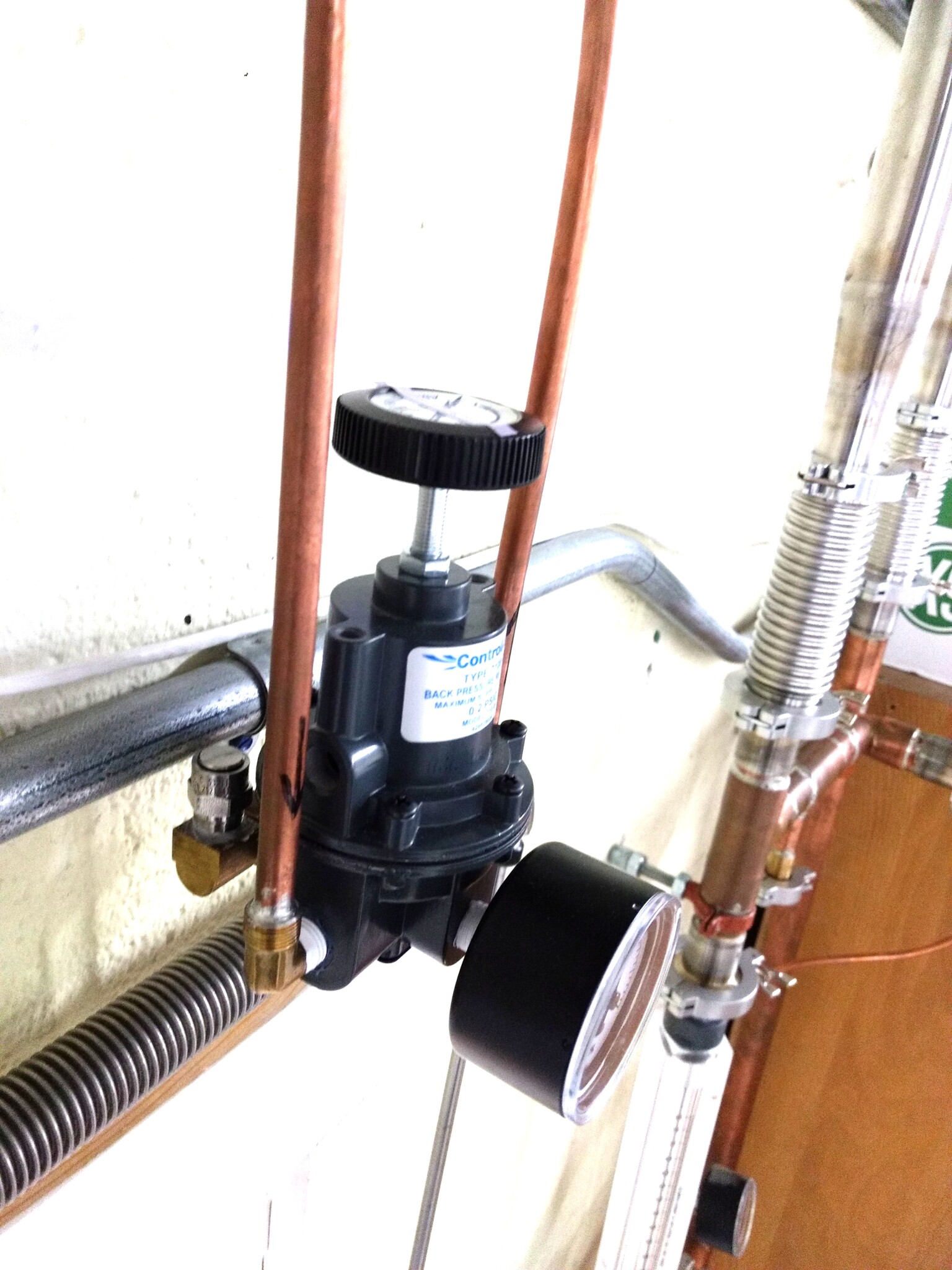
Several institutions use a mechanical back pressure controller to control the
pressure at the magnets. In my system, it maintains a back pressure of ~0.2psi.
I tried lowering the exhaust pressure close to 20 torr, ~ 1 atmospheric pressure
below ambient and the pressure on the input side held at ~0.2psi. Thus, it
should prevent the medium pressure compressor from sucking on the magnets.
On the body of this back pressure controller, I added a 0.5 psi pop off valve
just in case the medium pressure compressor should quit causing the pressure
in the system to build up.
In our helium recovery system, one backpressure controller services all 3 magnets.
Attached is a picture of the back pressure controller.
Regards
Yong-Wah Kim, PhD.
Director of NMR Facility
The University of Toledo
Department of Chemistry and Biochemistry
Phone: 419 530 2563
Email: Yong-wah.kim_at_utoledo.edu
________________________________
> From: main_at_ammrl.groups.io on behalf of Fulton, Luke via groups.io
> Sent: Friday, June 13, 2025 12:43 PM
> To: main_at_ammrl.groups.io
> Subject: [EXTERNAL] Re: [AMMRL] Quench narrowly avoided? Filling small magnets connected to helium recovery
Hi David,
That's a difficult question to answer.
The header itself doesn't have any shutoff valves to protect the magnets in=
case relative pressure were to go negative. One of several ball valves would
allow manual intervention in a pinch. I believe the liquefier/compressor have
more practical automatic protections buried in their designs. They are dauntingly
complicated. Unfortunately, I don't think I can share those schematics without
souring relations with QT.
The system has multiple closed loops, sensors, and valve controls. My compressor
has several times triggered automatically and run overnight without bringing
header pressure <0.2 psi, or siphoning liquid from magnets. So in practice,
the magnets are protected from vacuum...somehow. It's not clear to me how
many or which components would need to fail before losing that protection.
Kind regards,
Luke
Luke Fulton, PhD
CHEM BLDG R003
NMR Core Facility Director
Unit 3060
COR2E & Department of Chemistry
55 N Eagleville Road
University of Connecticut
Storrs, CT 06279
email: fko24003_at_uconn.edu
(alias): luke.fulton_at_uconn.edu
mobile: (603) 953-5275
Office: (860) 486-4069
________________________________
> From: main_at_ammrl.groups.io on behalf of David Richardson via groups.io
> Sent: Friday, June 13, 2025 11:40 AM
> To: main_at_ammrl.groups.io
> Subject: Re: [AMMRL] Quench narrowly avoided? Filling small magnets connected to helium recovery
Hi Luke,
Ok, great. I must have misunderstood what you were saying as it sounded to
me like the only thing isolating magnets from one another were the ball
valves on the manifolds, which obviously wouldn't be ideal.
Since we are already having a recovery discussion, do you have anything in
place to prevent the compressor(s) from pumping on the magnets? This would
be the result of something else failing, but having had balloon sensors fail
(along with another incident where a student made a very poor decision to
flip the compressor into "manual-on" mode and leave for the night) I have
had my compressor draw a pretty impressive vacuum on the building-wide lines.
Regards,
David
David Richardson, Ph.D.
Director, NMR Facility and Cryogenic Services
Office of Research
University of Central Florida
david.richardson_at_ucf.edu
407-823-2961
http://sciences.ucf.edu/chemistry/nmr/
________________________________
> From: main_at_ammrl.groups.io on behalf of Fulton, Luke via groups.io
> Sent: Friday, June 13, 2025 10:41 AM
> To: main_at_ammrl.groups.io <main_at_ammrl.groups.io>
> Subject: Re: [AMMRL] Quench narrowly avoided? Filling small magnets connected to helium recovery
Hi David,
The former. 3x magnets all connect to a shared copper pipe from which gas
feeds into the larger recovery equipment. Picture attached. Each magnet has
its own check valve to prevent exhaust from one magnet directly backflowing
into the other two. Those check valves should close if/when header pressure
spikes.
There's an additional ball valve where the whip connects to the copper pipe.
I only use it to isolate the header in case of maintenance on whip/manifold.
This one does seal off exhaust off flow, which as Bert pointed out is o
dangerous if closed and forgotten.
The copper header ranges from 0.2-0.29 psi and a small compressor pulls that
gas into the purifier/liquefier. If header pressure reaches 0.3 psi, as always
does during fills, a larger compressor moves gas into 3x medium pressure tanks
(MPT) for temporary storage. If for some reason the header reaches 0.4 psi
then a relief valve will open to vent excess pressure to atmosphere.
Conjecture on my part: I think everyone equips their magnets with a check valve
for routine operation to prevent atmosphere backfilling and creating ice blocks.
In labs without helium recovery, perhaps for half of the magnets we remove that
valve during fills and vent directly to atmosphere. Filling always pressurizes
the magnet. The question is how much, and technique and setup play a role. The
check valve adds a little more, 0.22 psi (15 mbarr) in my case, and the header
more on top of that. Empirically I think the dimensions of the manifold/tubing
can magnify those numbers, though my grasp on the physics is too slippery to
explain properly.
Kind regards,
Luke
Luke Fulton,
CHEM BLDG R003
NMR Core Facility Director
Unit 3060
COR2E & Department of Chemistry
55 N Eagleville Road
University of Connecticut
Storrs, CT 06279
email: fko24003_at_uconn.edu
(alias): luke.fulton_at_uconn.edu
mobile: (603) 953-5275
Office: (860) 486-4069
________________________________
> From: main_at_ammrl.groups.io on behalf of David Richardson via groups.io
> Sent: Thursday, June 12, 2025 8:31 PM
> To: main_at_ammrl.groups.io <main_at_ammrl.groups.io>
> Subject: Re: [AMMRL] Quench narrowly avoided? Filling small magnets connected to helium recovery
Hi Luke,
You mentioned they are chained together in some manner. Does the exhaust from
filling one magnet pressurize the other all way up to the ball valve? Or is
there an additional manifold and/or backflow control on the wall preventing
the exhaust of one from reaching the other?
Regards,
David
-=-=-=-=-=-=-=-=-=-=-=-
Groups.io Links: You receive all messages sent to this group.
View/Reply Online (#2424): https://urldefense.com/v3/__https://ammrl.groups=
.io/g/main/message/2424__;!!PvDODwlR4mBZyAb0!VkJBOnV0-tVcg4fKgpXTkWGh5DUlTn=
YZF9_-mvmD-7AyGN5qHCSJDMV1bKEBQHMkEp6seB6_yk324NgpII8n1z6fWZjQ$
Mute This Topic: https://urldefense.com/v3/__https://groups.io/mt/112337799=
/7559972__;!!PvDODwlR4mBZyAb0!VkJBOnV0-tVcg4fKgpXTkWGh5DUlTnYZF9_-mvmD-7AyG=
N5qHCSJDMV1bKEBQHMkEp6seB6_yk324NgpII8n19KO352v$
Group Owner: main+owner_at_ammrl.groups.io
-=-=-=-=-=-=-=-=-=-=-=-
(image/jpeg attachment: 0.5psig_pop-off_valve_on_magnet_side.jpg)