Date: Wed, 2 Jul 2025 14:30:09 +0000
Hi All.
Side note for safety: In principle, the physical plugs and sockets ought to
ensure that a 20A-rated instrument equipped with a 20A plug shouldn’t
be able to be plugged into a 30A outlet. However, in my experience this physical
incompatibility is imperfect. It’s important to ensure the connectors
are properly matched.
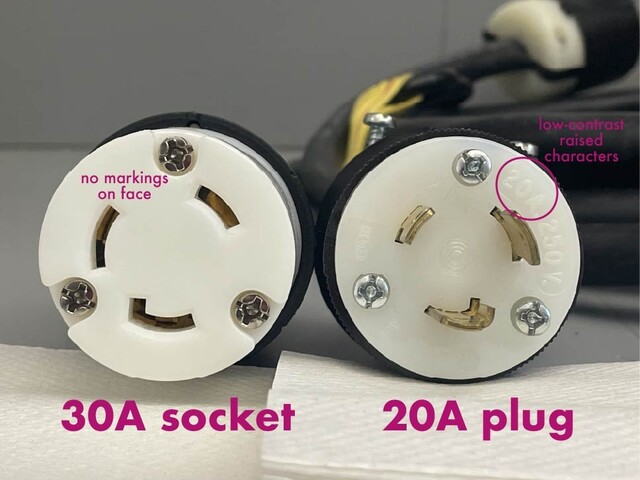
The U.S. three-prong twist-lock plug looks almost the same whether it’s
20A or 30A; the only difference I’ve found is the slightly larger
diameter of the arrangement of the conductors in the 30A connector. (see attached
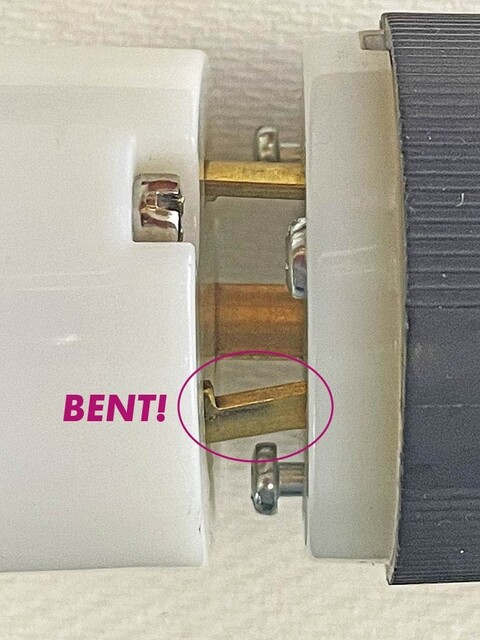
photo). I once discovered a spectrometer with a 20A plug inserted into a 30A outlet,
in which the metal prongs kind of bent out a bit, making electrical contact but
not mechanically secure with the twist. If you try pushing a 20A plug into a 30A
socket from an angle, it starts out easy, but as one pushes in it gets more
difficult. The resistance might feel like the connectors are just new and sticky,
but really the prongs are bending and the connection isn’t mechanically secure
(see attached photo). With enough force and bad judgement, one could make
electrical contact and call it a day, but that’s a bad idea. It’s important to
correctly match the plug and socket.
It can be very easy to not notice the 20A/30A difference, as you can see in
the photos of two connectors from my junk/spares drawer. You should always
inspect the markings on the connectors to be sure what they are, but this
can sometimes be difficult. They are often labeled with raised-texture
characters, so the numbers may black-on-black or white-on-white. These can be
difficult to read in areas like a UPS cabinet, close to the wall behind a
console, etc. Electrical connections seem to thrive in low-light,
difficult-to-access places.
Determining the amp rating of a plug or socket that’s in use can be
problematic because you can’t read the markings on the faces until
you disconnect them. A plug housing may be marked on its side, but if it’s
in use it may be very challenging to read the text, whether because it’s faint,
small, distant, or in the wrong rotational phase to be seen from a convenient
vantage point.
These incompatibilities have a way of surfacing at very inconvenient moments,
like when an engineer is on site for an installation. Best to get all the
connections straightened out ahead of any connection/disconnection event, and
to have spare connectors on hand to get through unexpected difficulties.
Thanks. Josh
> From: main_at_ammrl.groups.io on behalf of Michael Groves via groups.io
> Date: Wednesday, July 2, 2025 at 9:17 AM
> To: main <main_at_ammrl.groups.io>
> Subject: Re: [AMMRL] 30 amp service for AvIII Nanobay?
Hi Heather,
Others have already chimed in so there's not much that I can add. 30A is
the maximum current the UPS can supply, not the current it ALWAYS supplies.
And the nanobay console should have a 20A circuit breaker so that if the
current draw does go too high it will trip the breaker--hopefully protecting
the rest of the system from damage. I've harassed our electricians about this
a few times and I believe that as long as there's a 20A breaker protecting
the circuit it's up to code and should be safe.
I'm not sure which UPS you bought but if you've got one of the GXT5 series,
one possible solution would be to exchange the power distribution box on the
back for a 20A unit. And then you'd have to swap back to the 20A plug.
Cheers,
Mike
On Tuesday, July 1, 2025 at 04:22:07 PM MDT, Heather Schenck via groups.io wrote:
We had our University electricians in today connecting our 2010 vintage AvIII
Nanobay instrument to the house backup generator in case of longer power outages.
They also assembled the new Liebert UPS unit that we purchased for the system
recently.
When they reached the point of connecting the new UPS to the Avance console, they
found the UPS was set up to deliver 30 amp service while the console plug was 20 amp.
The way they resolved this (I had to leave for a medical appointment and was unable
to weigh in on this choice) was to replace the console's 20 amp plug with a 30 amp
plug to match the UPS outlet.
I have not powered up the instrument out of fear that 30 amps may fry some
components of our system, which is past its lifetime for maintenance support.
We cannot afford to replace the console if components fail.
I am sending this inquiry on a parallel path with an inquiry to Bruker. I have
no electrical competencies. Can anyone tell me whether a system designed to
run on 20 amps can be safely run on 30 amp service, or do I need to have
electricians back in to cut the plug (and UPS) down to 20 amp service?
Thanks for any reflections folks care to share.
Heather Schenck
hschenck_at_uwlax.edu
608 785 8288
-=-=-=-=-=-=-=-=-=-=-=-
Groups.io Links: You receive all messages sent to this group.
View/Reply Online (#2472): https://urldefense.com/v3/__https://ammrl.groups=
.io/g/main/message/2472__;!!PvDODwlR4mBZyAb0!S5y9PdZU-YvS_MUiXzW4GxrZ8WlxyL=
ymqiNGodExGiRBXeEK5NNs0dzodkHKQ_gF142TEi29oX5wClwCM8QuNZd0ZJwc$
Mute This Topic: https://urldefense.com/v3/__https://groups.io/mt/113938360=
/7559972__;!!PvDODwlR4mBZyAb0!S5y9PdZU-YvS_MUiXzW4GxrZ8WlxyLymqiNGodExGiRBX=
eEK5NNs0dzodkHKQ_gF142TEi29oX5wClwCM8QuNfcW8gBM$
Group Owner: main+owner_at_ammrl.groups.io
Unsubscribe: https://urldefense.com/v3/__https://ammrl.groups.io/g/main/lea=
ve/12177410/7559972/1125599165/xyzzy__;!!PvDODwlR4mBZyAb0!S5y9PdZU-YvS_MUiX=
(image/jpeg attachment: image001.jpg)
(image/jpeg attachment: image002.jpg)