Date: Fri, 18 Apr 2025 22:44:15 +0000
Hi Luke,
To lower the pressure at the magnet it would be good to move the one-way check
valve at the magnet to just before or after the small flow gauge with 1/4 in ID
plastic tubing. It would good to replace the ¼ inch ID Tygon tubing with
metal ones.
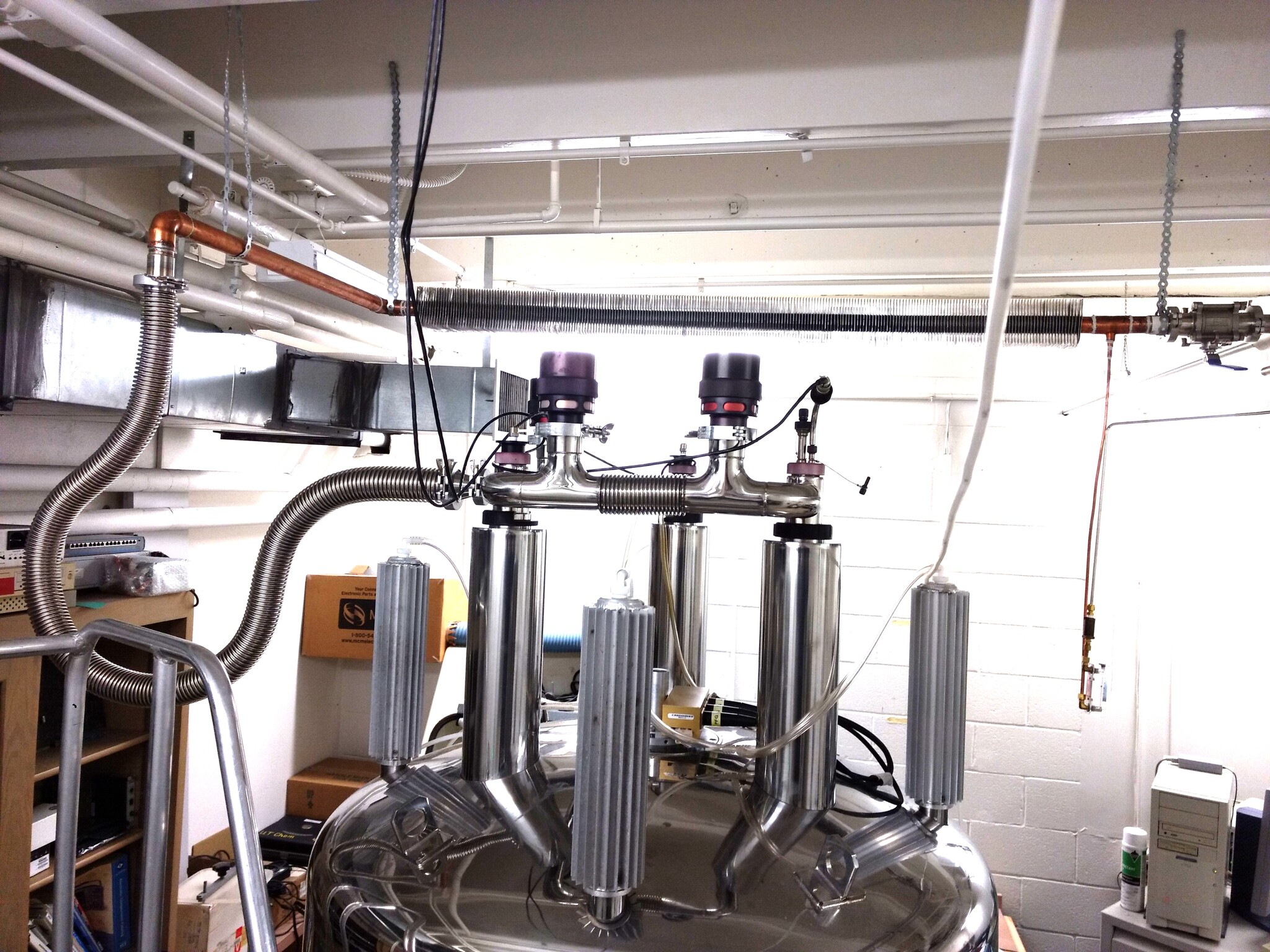
Attached are pictures of our Helium collection system. I believe
Less parts = less problem and easier to maintain. We use 2-inch diameter
stainless steel pipes. There is one flow gauge, one back pressure gauge and
one pressure gauge on the line going to the liquefier in the assembly at a
central location. The pressure gauges are in inches of water because the
highest pressure encountered is less than 0.3psi. Backpressure from ~200ft
of pipes is not noticeable during liquid helium fills. It is less than
0.05 psi when the other end is open to atmosphere. The flow gauge for
monitoring the flow rate during 'normal' magnet boiloff is to the right of
the heat exchanger hanging in mid air slightly higher than the doorway.
Liquid helium has a very low density. The backpressure from the one-way check
probably aggravated the situation.
Best
Yong-Wah Kim, PhD.
Director of NMR Facility
The University of Toledo
Department of Chemistry and Biochemistry
Phone: 419 530 2563
Email: Yong-wah.kim_at_utoledo.edu
________________________________
> From: main_at_ammrl.groups.io on behalf of Fulton, Luke via groups.io
> Sent: Friday, April 18, 2025 3:36 PM
> To: main_at_ammrl.groups.io
> Subject: [AMMRL] Quench narrowly avoided? Filling small magnets connected to helium recovery
Hi all,
I’m asking about the nitty gritty details of filling procedures while
connected to helium recovery. We made some troubling observations during our
most recent fill and want to identify/minimize risks for next time. It’s a
looong detailed story to read through. If anyone makes it to the end I’d
appreciate any opinions on what to change or if you agree with our conclusions.
My lab recently completed installing a full Quantum Technologies helium recovery
system. Each magnet’s helium exhaust port is connected to a copper header
line via manifold and long flexible whip. The header has a maximum pressure of
0.4 psi (before triggering relief valve), and each magnet has its own one-way
helium check valve, 15 mbar or ~0.2 psi. So at maximum I expect around 0.6 psi
back pressure while filling.
Historically we applied ~1.2-1.5 psi on the transfer dewar without any issue.
Fills went smooth, magnets stayed happy. We employed that same procedure for
our very first fill test during the install after connecting to the header.
At the end of the fill, helium liquid came shooting out from the fill port
upon removing the transfer line. Not fun. This happened on both an Oxford 600
and Bruker Ultrashield 300. We attributed it to the newly increased backpressure,
and having to relearn when to stop the fill.
Hoping to prevent it from happening again, this week we opted to lower the
pressure on our transfer dewar. Our hypothesis being the magnet was accidentally
over pressurized, and our historic pressures were no longer appropriate given
the new header connection. So we used 0.9 psi on the Ultrashield 300 this week,
and planned to lower it steadily near the end of the fill to end more gently.
Things went terribly.
Our helium level sensor usually “freezes” in the high 90’s
for a few minutes after putting in the transfer line stinger. As the fill
progresses the sensor unfreezes and provides a reliable impression of fill
progress. This time it never unfroze and we ended up flying blind from start
to finish. After eventually accepting that we had to operate without the sensor
we decided to stop the fill early. Better to regain our bearings than risk
overfilling. During this discussion, the flexible whip started to shake, which
happens when liquid enters the line from the magnet and rapidly converts to gas.
This surprised us, by our estimates the magnet shouldn’t have finished filling
yet. We stopped the fill and removed the transfer line from the magnet. Liquid
came shooting out the fill port. Again, not fun. The helium level unfroze
shortly afterwards and came in at a mere 86%.
The helium level sensor freezes at filling start because the stinger coats the
thermocouple in liquid. It should unfreeze as the fill proceeds because that
initial liquid drains from the helium stack into the internal dewar. It shouldn’t
remain frozen unless liquid is trapped there, by say an ice block, or unless
liquid reenters the stack, preferably because full. Liquid can’t eject
out the exhaust port without climbing the helium stack, again preferably because
full. But our sensor did remain frozen, and liquid did come out the exhaust port.
And at 86% the magnet is certainly not full.
We concluded that the dewar pressure was too low. It couldn’t decisively
overpower the back pressure, and the tussle between the two pressure sources
destabilized liquid contents within the magnet. We think the liquid was sloshing
dangerously. Perhaps there are niche details when working on lower field
superconductors with relatively small helium volumes, we’re not sure. That
all happened a couple days ago and not one user complaint since. The magnet
appears to be fine and we’re thankful we didn’t quench. Next
time we’re returning to our higher historical pressures and may revisit
the original plan to lower dewar pressure near the end for a gentle finish.
For those who read to the end you’re a saint. I’ll happily accept
any pointers and will attempt to answer clarifying questions. The situation spiked
my adrenaline to the roof, and I could do without that becoming routine.
Happy magnet happy manager.
Kind regards,
Luke
Luke Fulton, PhD
CHEM BLDG R003
NMR Core Facility Director
Unit 3060
COR2E & Department of Chemistry
55 N Eagleville Road
University of Connecticut
Storrs, CT 06279
email: fko24003_at_uconn.edu
mobile: (603) 953-5275
-=-=-=-=-=-=-=-=-=-=-=-
Groups.io Links: You receive all messages sent to this group.
View/Reply Online (#2253): https://urldefense.com/v3/__https://ammrl.groups=
.io/g/main/message/2253__;!!PvDODwlR4mBZyAb0!UE7EHDvjJKijuoXrCj7s_hTwriBcRa=
2xePYOscFwS-PNW8XzPtupYV4iqxLWJ9WPq1Jj2vPpEHSQ8isrJkRGALEOE7PC$
Mute This Topic: https://urldefense.com/v3/__https://groups.io/mt/112337799=
/7559972__;!!PvDODwlR4mBZyAb0!UE7EHDvjJKijuoXrCj7s_hTwriBcRa2xePYOscFwS-PNW=
8XzPtupYV4iqxLWJ9WPq1Jj2vPpEHSQ8isrJkRGAJ1mqXn-$
Group Owner: main+owner_at_ammrl.groups.io
-=-=-=-=-=-=-=-=-=-=-=-

(image/jpeg attachment: Flow_and_pressure_gauges.jpg)
(image/jpeg attachment: magnet_and_recovery_lines.jpg)